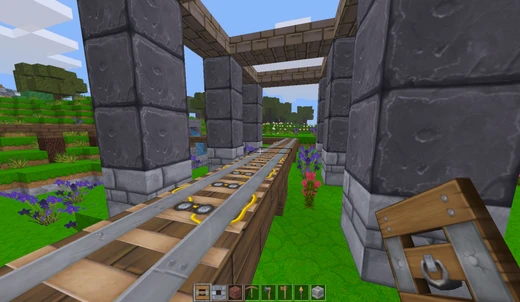
Sandbox game
A game genre emphasizing creative freedom and player-set goals.

Wikipedia / Wikimedia Commons
A sandbox game is a type of video game that gives players a high level of creative freedom, often without a fixed objective or with goals that players define themselves. These games may have no final endpoint at all, and are sometimes called non-games or software toys. The concept comes from a real sandbox, where people can build almost anything they like within its boundaries.
Early examples include space trading and combat games like *Elite* (1984) and city-building simulations such as *SimCity* (1989). The releases of *The Sims* (2000) and *Grand Theft Auto III* (2001) showed that games with complex, interactive systems that encourage experimentation could also be considered sandbox games. Some titles, like *Second Life* (2003), allow social interaction and sharing of user-created content online. Games such as *Garry's Mod* (2006) and *Dreams* (2020) let players use the game’s systems to build new environments and modes. *Minecraft* (2009) is the most successful sandbox game, offering both creative modes and progression-driven survival modes. *Roblox* (2006) lets users create their own games using the Luau programming language. *Fortnite* (2017) includes modes for competitive play or socializing.
**Terminology** In game development, sandbox design refers to systems that encourage free play. It can describe a whole game or a specific game mode, focusing on open-ended gameplay, relaxed rules, and few goals. It can also refer to a development approach where features are added slowly to a minimal experience, testing each element individually. There are many varieties of sandbox design, based on a wide range of dynamic interactive elements, so the term is used loosely without a strict definition. Designers sometimes define a sandbox by what it is not: subtract the missions, main campaign, or narrative that binds progression, and what remains is a sandbox.
The term is a metaphor for playing in a literal sandbox. Game historian Steve Breslin compares it to a child building a world from sand, as opposed to games with more pre-made content. Architectural scholar Alexandra Lange notes that a sandbox describes any bounded space offering freedom to explore and build, distinguishing it from conventional games—it is a “play space” for trying roles and quests rather than a structured “game.”
Sandbox design is often confused with open worlds, but they are separate
- field
- Video game design
- known_for
- Player freedom, emergent gameplay, minimal goals
- early_examples
- Elite (1984), SimCity (1989)
- notable_titles
- The Sims (2000), Grand Theft Auto III (2001), Second Life (2003), Garry's Mod (2006), Roblox (2006), Minecraft (2009), Dreams (2020)
Lore & Background
Early sandbox games took the form of space trading and combat games like Elite (1984) and city-building simulations like SimCity (1989). The release of The Sims and Grand Theft Auto III, in 2000 and 2001 respectively, demonstrated that games with highly detailed interacting systems encouraging player experimentation could also be seen as sandbox games. Some sandbox games involve the ability to interact socially and share user-generated content across the Internet, as in Second Life (2003).
Reader's Guide
Sandbox games represent a shift away from linear gameplay, emphasizing player creativity and emergent behaviors. From a development standpoint, sandbox design incorporates a range of game systems that encourage free play, with relaxed rules and minimal goals. The term is used often without a strict definition, and game designers sometimes define a sandbox by what it is not: subtract the missions, main campaign, or narrative, and you have a sandbox. Sandbox design is often associated with open worlds, but the two are disparate concepts; an open world allows free movement, while sandbox design requires creative aspects. Minecraft (2009) is the most successful example, offering both creative modes and progression-driven survival modes. Roblox (2006) allows users to create their own games using the Luau programming language. Sandbox design can also describe a type of game development where a designer slowly adds features to a minimal game experience. Some games offer a separate sandbox mode with fewer constraints, such as unlimited resources or disabled enemy threats, separate from the campaign mode.
Did You Know?
- The term 'sandbox' derives from the nature of a physical sandbox, which lets people create nearly anything they want within it.
- Sandbox games are sometimes referred to as non-games or software toys.
- Minecraft (2009) is the most successful example of a sandbox game.
- Roblox (2006) allows users to create their own games using the Luau programming language.
More in Sandbox games 1-24
Spotted an error? Know more?
This is a living reference — every entry is fact-audited, and reader corrections feed straight into our audit queue. Suggest an edit · See this site's audit record